Sign up for Lesson Plans, discounts & more!
The Ordovician Period
The Rise of The Cephalopods
This is all about the Ordovician Period: The climate, geography, and the major events that shaped life on Earth. Some plants and animals thrived while others became extinct.
The second period of the Paleozoic Era, The Ordovician rocks were first found in Wales, so its name comes from a tribe of people who once lived in the area where the rocks were found. The Ordovician began about 490 million years ago and lasted for about 47 million years.
The Continents-Gondwanaland
Gondwana was a huge
supercontinent during the Ordovician Period. It contained the modern
continents of Australia, Africa, Southern Europe, Antarctica and South
America. During the Ordovician Period, Gondwana gradually moved toward
the South Pole until it covered the pole at the end of the period. Most
of Gondwana was covered by water during the Ordovician.
The Continents-North America and Europe
Modern
continents of North America, Western Europe and Northern Europe were
located in the tropics, on or near the equator. These land areas were
sometimes covered with water and sometimes not. Toward the end of the
Ordovician Period more of the land was out of the water. This was due to
changes in the Earth’s climate.
Climate
During the
first parts of the Ordovician the climate was fairly warm. The land
uplifted and the continents moved around. When Gondwana stopped its
movement over the South Pole, glaciers formed. This caused the sea level
to drop and the climate to change. These changes led to a mass
extinction at the end of the Ordovician Period.
Life In The Seas of The Ordovician Period
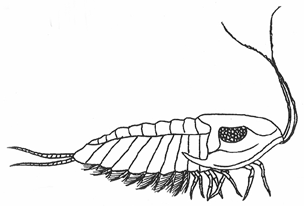
Life was still primarily found underwater, but there were more different species than ever before. The trilobites did not die out with the mass extinction at the end of the Cambrian period. Trilobites lived on and many new species developed.
The Rise of The Cephalopods
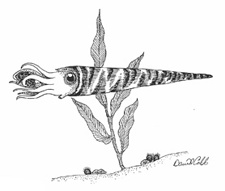
New animal forms developed, too. The cephalopods became the dominant predators of this period. Cephalopods are a group of mollusks that are related to octopus and squid.The orthoceras was a straight-shelled cephalopod that lived in the largest open end of its shell. Its feet came out of its head! They could rise and fall in the ocean water like a submarine. The siphuncle was a tube in the center of the animal. When filled with air, the animal’s body floated upward. A burst of air out the back end of the siphuncle pushed the animal forward.
Other Invertebrates
Brachiopods were also new in the Ordovician period. Brachiopods look like clams, but they do not belong to the same family. A brachiopod’s shells do not match. If you look closely, one shell is slightly larger at the hinge. The shells themselves each have bilateral symmetry. Clam shells have identical hinges so their shells are not symmetrical.
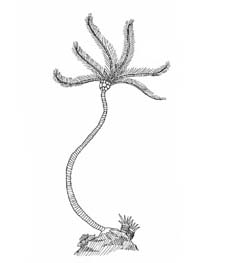
Crinoids were an echinoderm that looked like a feathery plant. They grew long “stems” and attached themselves to the ocean floor. The tentacles floated in the water. They caught the crinoid’s food.
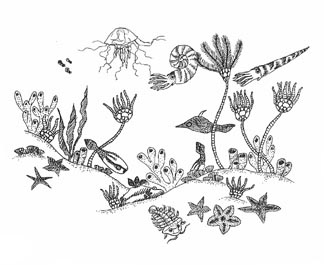
Sponges, corals and even primitive fish lived in Ordovician waters. The plant life in the water was red and green algae. On the very bottom of the oceans were the first animals with primitive backbones. They did not move very well, but they would grow to become the most important new animal group in the sea. The seas of the Ordovician Period were full of many diverse species.
The First Land Plants
Along the edges of the water, groups
of algae evolved into mosses and bryophytes. These plants must live in
watery environments so the water can flow directly into and out of their
cells. These plants had no veins for moving the water around inside
their bodies, so water had to flow between the outside environment and
the cells of the plants. These were true plants, because they had
chlorophyll and could make their own food.
There were fungi in
the water, too. Fungi feed on decaying matter. Fungi and algae left on
the bare land worked together to form lichen. The lichen could break
down the rock they lived upon. The broken rock became the first soil.
Return to Geologic Time Line
What came before the Ordovician Period?
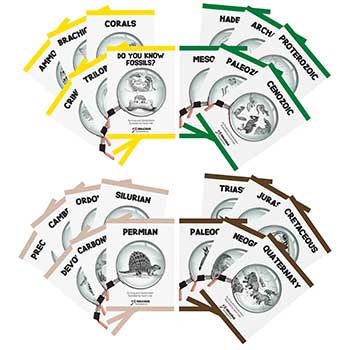
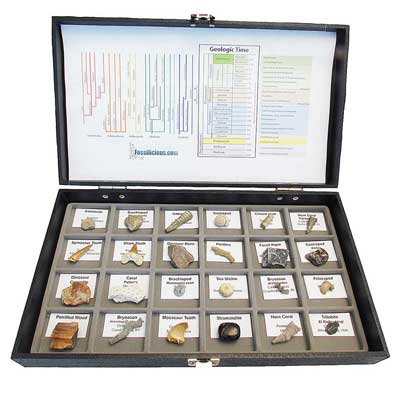
Check out some of the Educational Materials for sale on our sister site fossilicious.com.



interested in more? If so, you may want to check out our other sites:
fossilicious.com - Our online fossil and mineral rock shop.
rocksandminerals4u.com - An educational site about rocks, minerals, and geology.
 |
 |
 |
Geologic Time Geologic Time Line
Cenozoic Era
Quaternary
Neogene
Paleogene
Mesozoic Era
Cretaceous
Jurassic
Triassic
Paleozoic Era
Permian
Carboniferous
Devonian
Silurian
Ordovician
Cambrian
Archean Time
Hadean Time
Teachers Resources
Activities for Education and Fun
Earth Science Lesson Plans
Activities For Kids
Fossil Lesson Plans
Fossil Activities
Education Articles
Coloring Pages
Dinosaur Coloring Pages
Montessori Materials
Geology Club
Fossil Hunting
 |
 |
 |