Sign up for Lesson Plans, discounts & more!
The Paleozoic Era
From
The Cambrian Explosion To The Permian Extinction
So Much Change!
The Paleozoic Era, boy is there a lot to unpack here! From The Cambrian Explosion to The Permian Extinction, 290 Million years of dramatic change for the earth and the life on it!
There are 6 geologic periods each with its own climate, geography, plants and animals. It starts with the Cambrian and an explosion of life forms, the largest diversification of life ever. It ends with the Great Permian Extinction, the largest extinction event ever!
Prelude To The Paleozoic Era
There was certainly life before the Cambrian Period. There were even many complex life forms. In late Precambrian time was a period called the Ediacaran. Ediacaran fossils are found in the Ediacaran Hills of Australia, Northwest Territories, Yukon, British Columbia, Newfoundland in Canada, Russia, China, and Namibia just to name a few of the important places. There are many different types of Ediacaran fossils. What distinguishes these fossils is that there are no hard body parts to fossilize. This makes them very rare. Generally soft tissue disintegrates long before fossilization can take place, except in these few locations. The other distinguishing characteristic is that Ediacaran life forms are nothing at all like those of the Cambrian Period!
Before any of these multicellular Ediacaran Biota could exist something really important had to happen! It had to do with the single celled bacteria that lived during most of the 2,000 million years of the Proterozoic Eon. There were 2 basic types of bacteria heterotrophs and autotrophs. The heterotrophs got their energy by eating other bacteria. The autotrophs could get energy directly from the sun through photosynthesis. Photosynthesis makes a by product, oxygen.
Well no one knows exactly what happened or how it happened but somehow one or more heterotrophs ate some other bacteria but did not digest it. It lived inside the larger bacteria and helped it make energy!
This happened at least twice: once for plant cells where the smaller bacteria was cyanobacteria and became chloroplasts. and once for animal cells with the smaller bacteria developing into mitochondria.
The cells were able to reproduce as a partnership in a symbiotic relationship. These became a new form of life: The eukaryotic cell!
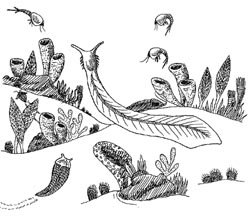
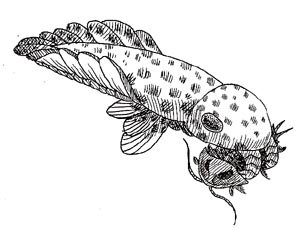
These new cells learned how to join together to do specialized tasks, the kind of specialization needed to make the tissues of plants and animals. Now species could exist that responded to the diversity of their watery environments. Some would live on the bottom sediments, burrowing with tube-shaped bodies or walking with many tiny legs. Others would live in the ocean column, developing fins for effective swimming like the pikia pictured here, a chordate from the Paleozoic Era Cambrian Period.
New Phyla
Many
phyla were represented in the Paleozoic Era. In fact all of the phylum
in today’s world were represented during the Cambrium Period. Some of
those representatives including: arthropods (Trilobites were everywhere!), mollusks, Lophophorata (Brachiopods), appeared almost immediately in the Cambrian while Orthoceras-a straight-shelled mollusk-came in around the Ordovician Period), echinoderms (The flower-like crinoid thrived in seas throughout the Era.) and, eventually, fish in the Devonian Period(. All of them had specialized tissues for performing the functions of their bodies: eating, breathing, moving, and reproducing.
Paleozoic Era Continents
The continents were mostly all joined together into the super continent called Gondwana. There was some movement of Gondwana but for the most part it was relatively stable and near the south pole. The land that would one day be North America was not a part of Gondwana. It was by itself near the Equator during the Paleozoic.
The Climate was also pretty consistent in the Paleozoic. Not much in the way of extreme heat or cold.
Life Moves Onto Land
Plants and animals first moved onto land in the Silurian Period. But they didn't really flourish there until the Carboniferous Period when huge forests covered the land. These forests were so dense and covered so much of the earth that oxygen was 35% of the atmosphere compared to present day levels of 21%.
Giant Insects
It
is this high oxygen content that is believed to be the cause of the
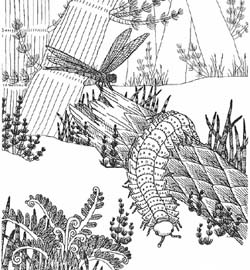
gigantic arthropods that lived in these forests. A dragonfly called
Meganeura had a wingspan 70 cm! The centipede like Arthropleura could
reach a length of 1.8 meters and giant scorpions grew over 50 cm long.
Of course there were an abundance of insects of sizes we would find
unremarkable as well.
Tetrapods
The high oxygen content
may have made it easier for the amphibians that also left the water
during the carboniferous period. These four legged creatures called
tetrapods lived at the waters edge. The tetrapods became very successful
evolving many different forms some of which grew quite large over 2
meters in length! They became the dominant life forms in the lakes,
rivers and swamps of the Carboniferous Period. The first reptiles showed
up late in the Carboniferous Period as well but they did not play an
important part during the Paleozoic Era.
Change is the way of life and the end of the Permian Period, the last of the Paleozoic Era brought about great changes.
Mass Extinction
At the end of the Paleozoic Era was an event called the Permian mass extinction. It was the greatest mass extinction event ever! At this time about 95% of all living things on earth became extinct! Not much is known for sure about the cause of this event. It could have been a large meteor impact. Or maybe a huge volcanic eruption. So far no evidence has been found to help us understand The Great Dying!
The wonder of life is that this ending made way for a new time and new life forms. The Mesozoic Era begins!
Preceeding the Paleozoic Era is the proterozoic
Next comes the Mesozoic Era
Return to the Clock of Eras
Check out some of the Educational Materials for sale on our sister site fossilicious.com.
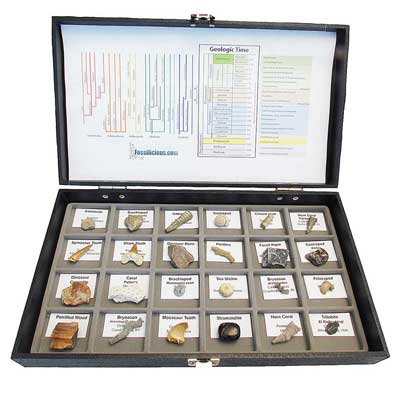

interested in more? If so, you may want to check out our other sites:
fossilicious.com - Our online fossil and mineral rock shop.
rocksandminerals4u.com - An educational site about rocks, minerals, and geology.
 |
 |
 |
Geologic Time Geologic Time Line
Cenozoic Era
Quaternary
Neogene
Paleogene
Mesozoic Era
Cretaceous
Jurassic
Triassic
Paleozoic Era
Permian
Carboniferous
Devonian
Silurian
Ordovician
Cambrian
Archean Time
Hadean Time
Teachers Resources
Activities for Education and Fun
Earth Science Lesson Plans
Activities For Kids
Fossil Lesson Plans
Fossil Activities
Education Articles
Coloring Pages
Dinosaur Coloring Pages
Montessori Materials
Geology Club
Fossil Hunting
 |
 |
 |